This Site Has Been moved View the NEW Motorcycletoday... http://motorcycletoday.9f.com/ Goldwing History 1978 GL1000 Thirty years ago, a pioneering Japanese motorcycle manufacturer created a machine that would set a new benchmark in motorcycle touring, or even motorcycling for that matter. In 1975 Honda Motor Company, Inc. introduced the Gold Wing. Otherwise known as the GL1000, its heart was a 999cc flat four-cylinder power plant. However, it was first tagged as a muscle bike and it looked a lot like other "standards" of the day, save for the heads lying low in front of the rider's feet. It's beginnings gave little hint to its future transformation into a first-class touring bike. The year 1978 saw the introduction of the now famous (or infamous as some would have it), Comstar wheels, in addition to an instrument 'pod' placed on the gas tank. Higher rising handlebars came the year before. It wasn't until 1979 that the bike received a set of hard saddlebags and trunk, and an official Honda fairing wasn't available until the 1980 GL1100 Interstate model, finally placing the bike in the true tour bike mode. It has continued in this direction ever since. An important note to the history of Honda: 1981 saw production of the Gold Wing move to Ohio, in a seemingly obvious maneuver to bolster their US presence. The Aspencade model of 1982 offered an electronically operated air pump for the suspension, CB radio and Clarion AM/FM stereo as standard equipment to set it above the Interstate model, on which those items were optional. Stepping up the horsepower game in 1984, the Wing was graced with an 1,182cc motor, although still a flat four. Some aficionados alleged this to be an answer to Yamaha's Venture. Whether one can believe it or not, fuel injection made its debut on the 1985 model, along with cruise control and an on-board "travel computer."
1988 GL1500 A long time in the saddle is what most of us dream of... A major wind of change blew across the indomitable touring bike in 1988, bringing with it a complete redesign with dramatic styling changes, a reverse gear and most importantly, a whopping increase to 1,520ccs of displacement, thanks to the addition of two more cylinders. This new flat-six engine configuration would become a hallmark of the Gold Wing. Aside from obvious modernizing changes in style, the bike we see today draws much of its lineage from this model. However, thirteen years of steady production ended to give way to the most current model: a new Gold Wing flying on an 1,832cc platform now known as the GL1800, graced with an all-aluminum frame, ABS and technology on loan from its sport bike cousins. Celebrating its 30th anniversary in 2005, Honda gave the venerable touring master a special badge, matching key and an opening banner display on the LCD dash to proclaim to the world a dominating history that any motorcycle would be honored to have. Other than the nice touches for its birthday, little has changed on the Wing since 2001, when it received a face-lift, new frame and the aforementioned displacement boost. Nevertheless, today's bike is even more of the legend that people have come to respect. Even the non-riding public knows a Gold Wing when they see one. After years spent growing up in Michigan and watching Wings sail up the highway in front of my house, I often desire to climb aboard the large machines and glide along to any place I wish, with complete comfort and confidence. No other motorcycle exemplifies the ability to do just that as well as a Honda Gold Wing. "With this standard-setting motorcycle going stronger than ever, it's easy to see another thirty years of production in its future."


------------------------------------------------------------------------------------------------
2008 Harley-Davidson FLSTSB Cross Bones Review
Back in January of this year, both father and son, Willie G. and Bill J. Davidson, were on hand at the infamous Viper Room on Sunset Blvd. in Hollywood, CA, to uncover, literally, the latest addition to not only the Softail line, but also to what is something of a phantom line-up. That snaky venue was the perfect setting, and likely chosen for both its dark motif and equally dark vibe, for Harley to officially announce what it calls Dark Customs. These shadowy figures are various bikes from other model platforms that all carry a common darkened theme. The Dark Customs currently are: Sportster 1200 Nightster (XL1200N), Night Rod Special (VRSCDX), Dyna Street Bob (FXDB), Fat Bob (FXDF), Night Train (FXSTB) and the Cross Bones (FLSTSB).

The 2008 Harley-Davidson FLSTSB Cross Bones. |
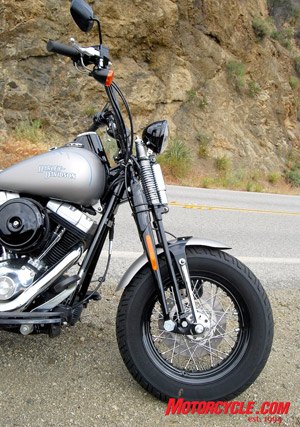
A chopped front fender keeps the eye focused on the fatty front rubber and springer suspension. |

Von Dutchery |

Sheesh! Looks painful, no? The solo springer seat is adjustable fore and aft in two positions and is surprisingly comfortable. |
Most of the Dark Customs eschew the gleam and sparkle of acres of chrome and flashy paint for black-finished parts like mirrors, hand and foot controls, engine finish, headlamp nacelle, wheels, so on and so forth. If all those bits on a particular model aren’t blackened, as is the case with the shinier Night Train or Dyna Street Bob, then, at a minimum those bikes wear darker, simpler colors, often in a matte finish.
I enjoyed my time on one of the early entrants to the Darks, the Nightster, when we tested it a little over a year ago, well before the words Dark Custom were ever uttered. The Cross Bones follows the Nightster’s pattern of dark, black bits everywhere. The rear fender struts, swingarm, oil tank, round air cleaner cover, old-skool half-moon rubber-cushioned floorboards, handlebars, mirrors, turn signals, tank-mounted speedo including idiot lights, headlamp, springer front-end, front fender bracket, and laced steel wheels all have a deep black luster. About the only pieces that aren’t black are the gas cap, engine covers and dual slash-cut exhaust.
What sets the Cross Bones apart from bikes in the Softail line as well as some of the other Dark Customs is its nod to the bike-bobbing past. Mini ape-hanger rubber-mounted handlebars are an easy cue to the direction the bike’s styling is headed. The front fender is minimal; it boldly displays the chubby 5-inch wide, 16-inch Dunlop D402 tire. The rear fender follows suit as it gives plenty of exposure to the 200mm-wide (7.8”) 17-inch tire, also a D402.
'Capping off post-war styling is a simple paint scheme that’s tastefully accented with Von Dutch-style pinstriping.'
Should you purchase or take a spin on this retro ride, take note. Its adjustable two-position tractor-style solo springer saddle will have you starting and ending your trip all alone. This one-man-band saddle leaves the rear fender naked, accentuating its long look. Furthering the bare and vintage appearance out back is the pseudo hardtail look that Softails emulate by using two horizontally-mounted shocks that hide underneath the bike. Rear suspension travel is in line with most of the other Softies at 4.3 inches, but the Bones’s front travel is a hair over an inch less than the other models at 3.8 inches. Capping off post-war styling is a simple paint scheme that’s tastefully accented with Von Dutch-style pinstriping.
I admire Harley-Davidson as a company for a number of reasons. One reason being that, like BMW, the company is a masterful alchemist, able to extract several bike models all from one basic platform. The basic Softail chassis is in place on the Cross Bones – save for the front end. Powering this new old bike is the same Twin Cam 96B that every bike model beginning with an F gets. The fuel-injected 45-degree air-cooled 96ci Twin is rigid mounted and counter-balanced – hence the B in its name. The venerable workhorse is matted to a six-speed gearbox.
Expecting one thing, getting another
Years ago, long before I could give two hoots about motorcycles, I was more interested in bicycle racing. In one race I learned a great life lesson. Before the race started I sized up the competitors – their gear and bikes the latest and greatest – and surmised that I was in deep doodoo. Near races’ end I had passed at least three-quarters of the field. Lesson? Preconceived notions shouldn’t see the light of day. In the case of the Cross Bones, I was dead-wrong about my suspicions that such a simple front-end and seat wouldn’t be able to provide good ride quality and performance.
The solo seat sits 30 inches off the ground and is the most comfy cruiser seat in my recent memory. It feels simply as if it had been custom made and perfectly shaped just for me. Neither freeway nor surface street miles had me fidgeting with mild numbness or soreness. Next to be struck from my list of presumptions was what I thought would be inherent discomfort and poor input response from the mini apes. To my surprise I never felt stretched too far forward and only suffered discomfort from arm pump while doing my best impersonation of a spinnaker sail when hammering down the freeway in excess of 80 mph. The rubber-mounted bars offer a good blend of comfort and functionality.
The vintage-inspired half-moon floor boards also have vibe-isolating properties courtesy of rubber tops, and offer a relaxing place to park your boots. But, the combination of their forward bias and a large boot size may create difficulty in wiggling your left foot out in a hurry from under the heel-toe shifter.

Despite what it may look like, this is a rather comfortable riding position, especially around town and in the country. Blitzing down the freeway means less comfort as the open riding position makes a big wind scoop out of the rider.
That seat I like so much is accented by a braided leather tank strap that visually connects it to a simplistic instrument console mounted on the 5-gallon tank. The console is so simple in fact that the analog speedo only reads in single and double digits with a “MPH x 10” reminder at the bottom. It’s inlayed with a tiny LCD displaying time, dual tripmeter, odo, low fuel and oil warning. The usual array of idiot lights blends inconspicuously into the console, only appearing when lit. As slick as the instrument package is, I should note that while wearing a full-face helmet I was forced to tilt my head down to see the gauges, thereby taking my eyes off the road for whatever length of time.
Putting the Cross Bones in its natural habitat of urban surface streets and fun canyon roads was the first place I realized that I expected one thing from this motorcycle and it gave me something else.

Yet another area of surprise is the Bones’ handling. Good leverage from the handlebars means light steering effort, and the large tires don’t impede handling.
Shock and amazement! The big bobber imitator rides like a dream. The fat front and rear tire combo doesn’t hinder steering or make the bike run wide in corners. Mind the lean angles, though, as is the case with any cruiser, ground clearance is an issue. Holding a smooth continuous arc is effortless, belying the bike’s 737-lb claimed wet weight. No small feat considering, for example, that the Bones weighs a full 55 pounds more than the Night Train with fuel, etc.

The retro springer front-end looks hellacool and is nicely accented by the simple headlamp. Ride quality is surprisingly good save for really crummy pavement or sharp-angled bumps. |

The dark horizon is befitting of the dark image Harley has chosen for its newly themed bikes called Dark Customs. |
Half expecting chassis flex in quicker transitioning corners, I was doubly pleased that I experienced little, if any, movement in the frame. The low-tech front provided excellent damping over just about every surface with the exception of high-speed (steep-angled) bumps. The simple spring and associated covered and chromed shock simply can’t react fast enough and with enough damping to soak up such imperfections. Otherwise, it was sufficient.
Extended freeway time may or may not be a chore depending on your chosen rate of travel. Anything above 80 mph or so can be work not only holding on against the wind, but the classic springer front end starts to resemble riding a several-hundred-pound jackhammer. Keep freeway speeds reasonable and you’ll feel as cool as you look.
'I would stop and look at it and think, “Man, this is one good-looking Harley. I can’t think of anything about it I’d want to change.” The Cross Bones has become my new favorite Harley-Davidson.'
Harley-Davidson may have turned back the hands of time in styling the Cross Bones, but not at the cost of forward progress in performance. This bike has a smooth, responsive ride in all but the upper reaches of the speedometer; the reliable Twin Cam 96B is plenty torquey and smooth. The six-speed transmission isn’t the slickest shifting but it engages with the reassuring ka-thunk that it’s proudly American made. The single-piston, single-rotor front brake works well, but the two-piston rear brake works better. Throttle response is good, and the note emanating from the custom-looking exhaust sounds like it just slipped under the EPA’s radar, but an observed 32 mpg should keep the agency happy.
More important than the Cross Bones’ abilities is its obvious aesthetic appeal. I often found myself passing the bike in the garage only to get caught in its hypnotic pull. I would stop and look at it and think, “Man, this is one good-looking Harley. I can’t think of anything about it I’d want to change.” The Cross Bones has become my new favorite Harley-Davidson.
Whether you’re ready to relive your past or are young and want a tie-in to motorcycling’s days gone by, the Cross Bones may be your fountain of youth. The price of admission starts at $16,795; available colors are Vivid Black, Olive Pearl, Dark Blue Pearl, Black Denim, Pewter Denim and Dark Blue Denim.
-----------------------------------------------------------------------------------------------------------------------------------------------------------------------
Kawasaki has released information for two early 2009 streetbikes, the Ninja 500R sportbike and and the Vulcan 500 LTD cruiser.
The beginner-friendly Ninja 500R returns with the same setup as in 2008 but with a change in color. The 2009 model will be available in ‘Candy Plasma Blue’ instead of 2008’s ‘Passion Red’. The ‘Metallic Diablo Black’ will also return, but the red striping has been replaced with gray.
The 2009 Ninja 500R will again be powered by a 498cc liquid-cooled, parallel twin four-stroke engine with dual overhead cams and four valves per cylinder.
The 37mm front fork has thin walls for light weight and rigidity while the rear will feature a bottom-link UNI-TRAK suspension providing a low center of gravity.

The 2009 Ninja 500R is available in 'Candy Plasma Blue'.
Also targeted for first-time motorcyclists, the Vulcan 500 LTD will also return in 2009 with a just a change in color scheme coming in ‘Metallic Imperial Red’ instead of 2008’s ‘Ebony’ black.
The Vulcan 500 LTD’s engine is designed after the Ninja 500R’s, providing a sportbike’s heart in a cruiser’s body with its stepped seat, bobbed rear fender, tank-mounted speedometer and chrome-plated wire-spoke wheels.

The Vulcan 500 LTD runs a similar engine to the Ninja 500R.
The 28.1-inch seat height and Kawasaki’s Positive Neutral Finder (also available on the Ninja 500R) help make the Vulcan 500 LTD a good choice for new riders.
----------------------------------------------------------------------------------------------------------------------------------------------------------------------
Suzuki has released information on its early 2009 models, all receiving styling updates to their 2008 models.
Suzuki’s championship-caliber motocross bikes will be back in 2009.
The RM-Z450 will return with only minor style changes, after undergoing a major overhaul in 2008 with the addition of electronic fuel injection with a fuel pump enclosed inside the fuel tank. Steve Ramon piloted the RM-Z450 to the 2007 World MX1 championship and he currently sits second in the 2008 championship standings, just six points behind Yamaha’s David Phillipaerts.
The RM-Z250 will also be back for 2009, with similar graphical upgrades. Ryan Dungey recently rode the RM-Z250 to win the AMA East/West Lites Shootout for the second year in a row.
The two-stroke RM85 will also return, however the RM250 and big-wheeled RM85L didn’t make the cut.
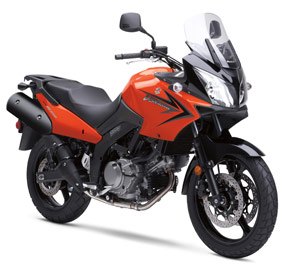
Suzuki didn't announce any major changes to its early 2009 lineup including the V-Strom 650, save for color and graphic changes.
Suzuki’s V-Strom line will also return. The V-Strom 650 will again be available with or without ABS brakes. The 2009 versions will come in new colors with a choice of orange or gray instead of 2008’s flat black and yellow options. The ABS version, however, will only be available in gray. The V-Strom 1000 will also be back, but only in black.
All V-Strom bikes will feature the digitally-controlled Suzuki Dual Throttle Valve (SDTV) fuel injection system with Automatic Fast Idle System (AFIS).
Suzuki’s 2009 Dual-sport line will again be headed by the DR650SE. Its four-stroke, four-valve, single-cylinder engine will again feature the Suzuki Advanced Cooling System with additional piston-jet and engine oil cooling. Also available are the DR-Z400 and its supermotard sibling the DR-Z400SM, as well as the newbie-friendly DR200SE. All 2009 Suzuki Dual-sports will come in black or white except the DR200SE, which is only available in black.
-----------------------------------------------------------------------------------------------------------------------------------------------------------------------
The XR1200 is as close to a true sportsbike Harley-Davidson is ever going to make (except for the ill-fated VR1000 Superbike –Ed.). It’s air-cooled with a modified 1203cc Evolution V45 from the Sportster range. To make it more powerful than the rest, the XR1200 features a larger air-box, downdraft fuel injection and a performance-biased exhaust system. The result is a claimed 90 horsepower at 7.000 rpm and 73.8 ft-lbs of torque maxing at a low 3.700 rpm.
.jpg "2008 Harley-Davidson XR1200. Only in Amer... er, um... Europe.")
2008 Harley-Davidson XR1200. Only in Amer... er, um... Europe. |
.jpg "The XR1200 puts out a claimed 90 horsepower at 7,000 rpm and 73.8 ft-lbs of torque maxing at a low 3,700 rpm. The enlightened will know that a Buell makes more horsepower than this with similar technology.")
The XR1200 puts out a claimed 90 horsepower at 7,000 rpm and 73.8 ft-lbs of torque maxing at a low 3,700 rpm. The enlightened will know that a Buell makes more horsepower than this with similar technology. |
.jpg "Scott Parker (in the leathers) is a 9-time AMA flat-track champion.")
Scott Parker (in the leathers) is a 9-time AMA flat-track champion. |

The dual over-under up-swept exhaust is a signature design item and iconic to the XR1200's inspiration, the XR750 flat-track dominator. |

Riding the XR1200 aggressively through mountain passes and valleys was a very pleasing experience. Tor had to keep reminding himself that he was on a Harley, not a Buell! |
The enlightened will know that a Buell makes more horsepower than this with similar technology. The reason the XR1200 doesn’t make a full 100 horsepower was explained to me by one of the Milwaukee engineers as being down to a lower volume airbox and different exhaust system. Harley-Davidson would never ever sacrifice style completely over performance and that is the reason.
The XR1200 sure makes a presence different to most other motorcycles. It’s unique from the Motor Company, and the only other motorcycle on the market I can find for some sort of comparison would be the Euro-only Yamaha MT01!
At the same time, if it hadn’t been for the 1970 launch of the 90-horsepower XR750 for flat-track racing, we would not have seen the XR1200. That the new 1200 makes the same horsepower as a 38-year-old bike will have to be forgiven, as modern noise and emission regulations don’t allow for much more.
'The XR1200 sure makes a presence different to most other motorcycles.'
This early morning in April, I have the privilege of following Wrecking Crew member number 1 Scott Parker into the mountains on the XR1200. Parker is 9 times AMA champion and the most successful rider on the most successful flat-track racebike ever.
Not long after, Scott Parker and Brommie stunt-monkey Craig Jones were doing monos worth a gold medal up in the mountains. There’s no doubt in my mind after doing some of my own, this Harley is the most fun Harley-Davidson I have ever ridden! So it wheelies, but even more impressive is the ability to go fast through the tight corners in the Spanish mountains. True, the XR1200 is pretty much heavier than any other European brand motorcycle it is supposed to compete with. But once on the move it handles brilliantly and the monstrous torque curve is just a delight to use.
This Harley has got tires to match its abilities fully in the Dunlop Qualifiers. Using an 18-inch flat-track-style front wheel, the Qualifiers have been specially designed for the big Harley. With a 551-lb claimed dry weight, the XR is probably a little bit heavier than what the Qualifiers was intended for in the first place. But never mind, they stick like glue to the tarmac and only the footpeg feelers touch the ground. To me, those footpegs and feelers are the most annoying thing about the XR1200 package. At a standstill, I hit the feelers with my ankles, and getting back on the move I drag the footpegs up and they haven’t got spring action to bring them back down again. The Harley engineers that I spoke with told me that this was the first issue that they would address ahead of mass production scheduled for this spring.
The seat is quite thin and sporty, and the seat height is a low 29.2 inches. The handlebar is very wide and this makes it easy to wrestle the XR to its sides. The lean angle is very good, but despite the fact that it looks like the right exhaust side will touch ground first, it’s actually the typical Harley sidestand on the left that will touch first. The clutch cable looks fairly exposed and as if it will start grinding leaning the XR to its extreme left. It shouldn’t and it didn’t, it just looks that way. The whole mid-placed exhaust cover will grind on the right-hand side. Despite the fact that the XR1200 is the sportiest Harley ever, it still has got plenty of styling compromise.
Harley aficionados will frown upon the fact that there’s a plastic tank and rear fairing sides on the XR1200. The headlight is a standard Sportster item, and the double rear shocks remind me of a Sportster too. The travel is a short 3.5 inches at the back and 4.9 inches from the 43mm USD fork. That aluminium swingarm does not remind me of anything found on other Harleys, though. It looks technical and light.
Mounted on the 18-inch front wheel is a pair of 4-piston Nissin calipers providing plenty of stopping power. I can’t help it, but I am really glad that Harley-Davidson have kept Harley clutch and brake levers as they feel really good to use. The 5-speed gearbox was brilliant and not heavy to use at all.
Riding the XR1200 as hard as I dare through the mountain passes and valleys was a very pleasing experience. I had to keep reminding myself that I was on a Harley launch and not a Buell launch! Not that the XR 1200 feels anywhere remotely like a Buell. It’s too big for that but still handles so well. With the XR1200 working hard under you, it should be much easier to keep up with your friends on sportsbikes. You won’t go faster, but certainly as fast in many places.
On my way back from the mountains and into Valencia I got to test the city-riding qualities. The XR1200 filters like no other Harley, apart from maybe the Nightster. One of the major differences that make the XR1200 is the fact that it has got top tires that gives you the extra safety to go a little bit faster everywhere, also in town. A little bit too much heat radiation is my only town-riding complaint.
